
Article
AI Tools vs AI Models: What’s the Difference?
A plain-English guide to the apps you use and the engines underneath them

It is the question we get most at LOKAL, from clients in Manila and Sydney and from the rooms we run AI workshops in: is ChatGPT an “AI tool” or an “AI model”? The two words get used interchangeably, but the difference decides what you pay and what you can build. Here it is the way we draw it on the whiteboard.
The engine and the car
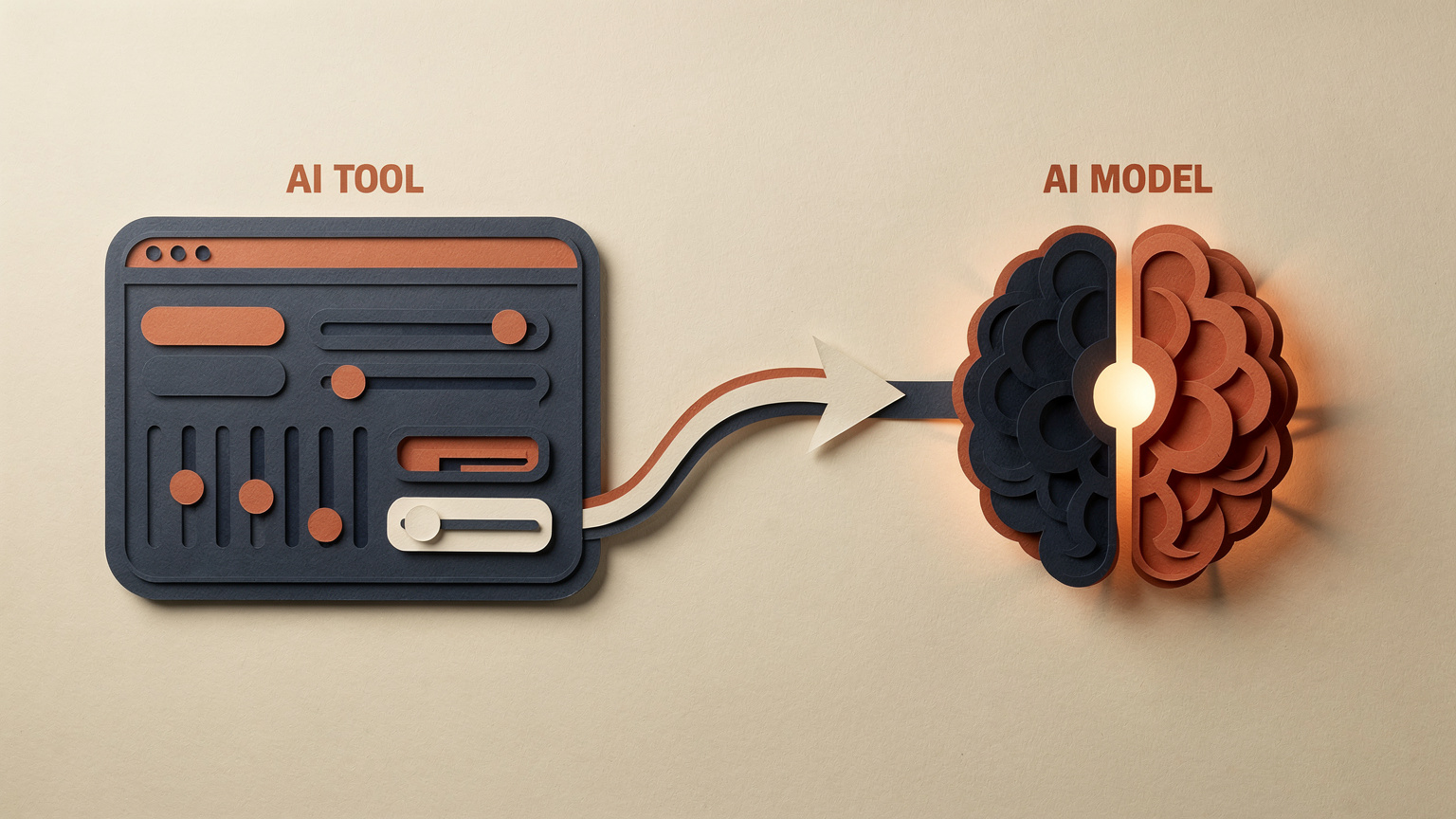
An AI model is the engine. An AI tool is the car you drive.
The model is the trained system that does the actual thinking, turning your words into an answer. The tool is the app you open, with buttons, a chat box and a monthly price, that puts that engine where you can use it. You type into the tool, and the model does the work behind it.
What is an AI model?
An AI model is a program that has been trained on a very large amount of data to do a specific job. The models everyone talks about in 2026 are large language models, or LLMs: systems trained on enormous quantities of text so they can predict, sentence by sentence, what a helpful response looks like.
GPT-5 (from OpenAI), Claude (from Anthropic), Gemini (from Google), and DeepSeek (from China) are all models. On their own, a model is not an app you log into. It is something software talks to through an API, billed by the token, which is roughly a few characters of text. Developers pay, say, a few dollars per million tokens. That is how a model is priced and sold.
Picture a car engine on a workbench. It is powerful, but you cannot drive a workbench. Someone has to build a car around it first. A model is that engine.
What is an AI tool?
An AI tool is the finished product built on top of one or more models, designed for people rather than programmers. It has a friendly interface, a free tier or a monthly subscription, a phone app, and features like voice, image generation and file uploads added on top.
ChatGPT, Claude (the app), Gemini, Perplexity, Canva, Grammarly and Midjourney are all AI tools. You do not pay per token to use them; you pay a flat monthly fee, or nothing at all on a free plan. The tool handles the plumbing: talking to the model, saving your history, adding search and memory, so you can just type and get an answer.
“ChatGPT” is the tool you open. “GPT-5” is the model running inside it. Same company, two different products.
Side by side
| AI model | AI tool | |
|---|---|---|
| What it is | The trained engine | The app you use |
| Examples | GPT-5, Claude Opus, Gemini, DeepSeek | ChatGPT, Canva, Grammarly, Perplexity |
| Who uses it | Developers, via an API | Everyone, via an app or website |
| How you pay | Per million tokens | Monthly subscription (often a free tier) |
| You interact with it by | Writing code | Typing, talking, clicking |
Many of the big names are both. OpenAI sells the ChatGPT tool and the GPT model family. Google sells the Gemini app and the Gemini API. That is why the two words get mixed up, and why our directory of AI tools and models lists each brand with both its subscription price and its per-token model price in one place.
Where LLMs and “generative AI” fit
A few more words people use as if they mean the same thing:
- AI is the whole field, decades old, covering everything from spam filters to self-driving cars.
- Machine learning is the part of AI where systems learn patterns from data instead of being programmed with fixed rules.
- Generative AI is machine learning that creates things, text, images, audio, rather than just sorting or scoring them.
- An LLM is a generative-AI model that works with language. It is one specific kind of AI that is very good with language, not a synonym for AI.
So when someone asks “AI or LLM?”, the answer is that an LLM is AI, just a narrow, text-focused slice of it. Every LLM is AI; not every AI is an LLM.
A subscription versus a token bill
The pricing model is the clearest way to tell a tool from a model.
Tools charge a subscription. A flat monthly fee, predictable, with a free tier to start. ChatGPT Plus, Claude Pro and Perplexity Pro all sit around US$20 a month. You can use them as much as the plan allows without watching a meter.
Models charge per token. You pay for exactly what you process, measured in millions of tokens, split into a cheaper input price and a pricier output price. A frontier model might be a few dollars per million tokens; a budget model like DeepSeek is a fraction of that. This only matters if you are building software that calls the model thousands of times.
Which one do you need?
For almost everyone, the answer is a tool. If you want to write, research, make images or get help with work, pick a tool, ChatGPT, Claude or Gemini are the usual starting points, and you never have to think about the model underneath. Our guide to AI in the Philippines walks beginners through choosing one.
Once the tool-versus-model distinction clicks, the next three words you will hear are agents, MCP and Skills — a model wired up to act, the standard that connects it to your systems, and the instructions that teach it your way of working. We unpack all three in the 3-word AI stack, explained.
You only need to choose a model when you are building software: an app, an automation, a chatbot of your own. This is the side we work on at LOKAL when we ship client automations, where a model’s quality, speed and per-token price become the whole decision. Whichever side you are on, the AI tools and models directory lays out every option side by side, with Philippine and Australian pricing, so you can see exactly what you are choosing between.
FAQ
Common questions
What is the difference between an AI tool and an AI model?
An AI model is the engine: a trained system like GPT, Claude or DeepSeek that turns your input into output. An AI tool is the app you actually open and use, like ChatGPT, Canva or Grammarly, which wraps one or more models in a friendly interface. The model is the engine; the tool is the car.
What is an AI model?
An AI model is a program trained on large amounts of data to perform a task, such as predicting the next word in a sentence. Large language models (LLMs) like GPT-5, Claude and Gemini are the best-known type. Developers pay for models per million tokens of text processed.
What is an AI tool?
An AI tool is a finished product built on top of one or more AI models, designed for everyday people. ChatGPT (the app), Canva, Grammarly and Perplexity are AI tools. You usually pay a monthly subscription, and many have a free tier.
Is ChatGPT a tool or a model?
Both names get used, which is the root of the confusion. "ChatGPT" is the tool: the app and website you log into. "GPT-5" is the model: the engine running inside it. OpenAI sells ChatGPT as a subscription and GPT models as a per-token API.
Is an LLM the same as AI?
No. AI is the broad field. A large language model (LLM) is one specific, very successful kind of AI that works with text. All current LLMs are AI, but plenty of AI (image recognition, recommendation systems, older machine learning) is not an LLM.
Do I need to choose a model, or just a tool?
Most people only ever need to choose a tool: pick ChatGPT, Claude or Gemini and start. You only need to choose a model directly if you are a developer building software on an API, where the per-token price and quality of the specific model matter.
Keep reading
Related reading
Done-for-you
Would you rather a team ran this for you?
LOKAL runs Total Visibility for brands across AI search, SEO, and marketplaces: strategy and execution under one roof.