
 ChatGPT
 Corporate AI Training — Philippines
Train every department on real work — then prove it stuck 90 days later
Corporate AI training run as a 90-day rollout, not an away-day.
LOKAL’s corporate AI training in the Philippines trains each department on its own weekly workflows — CX on ticket triage, finance on reconciliations, marketing on briefs — then follows the whole company through a 30/60/90-day adoption plan that ends in real usage numbers, not a feedback form. We’ve trained 5,000+ professionals across 65+ corporate clients, including a 4,000-staff enterprise rollout that held 72% weekly AI use. Onsite in Metro Manila, or live online anywhere in the Philippines, in English or Taglish.
Also available in
We train on the tools your company already runs
ChatGPT  Claude
  Copilot
  Gemini
  NotebookLM
 Why tracks, not town halls
A compliance officer and an investment analyst are not the same learner.
The standard corporate AI training is one big session: a slick vendor demo, some applause, and three weeks later nobody has opened the tool again. The fix isn’t a better keynote — it’s training each department on its own work. The inbox CX actually answers, the reports finance actually files, the briefs marketing actually writes. Every track leaves with something it can use the next morning, and that deliverable is what carries the habit back to the desk.
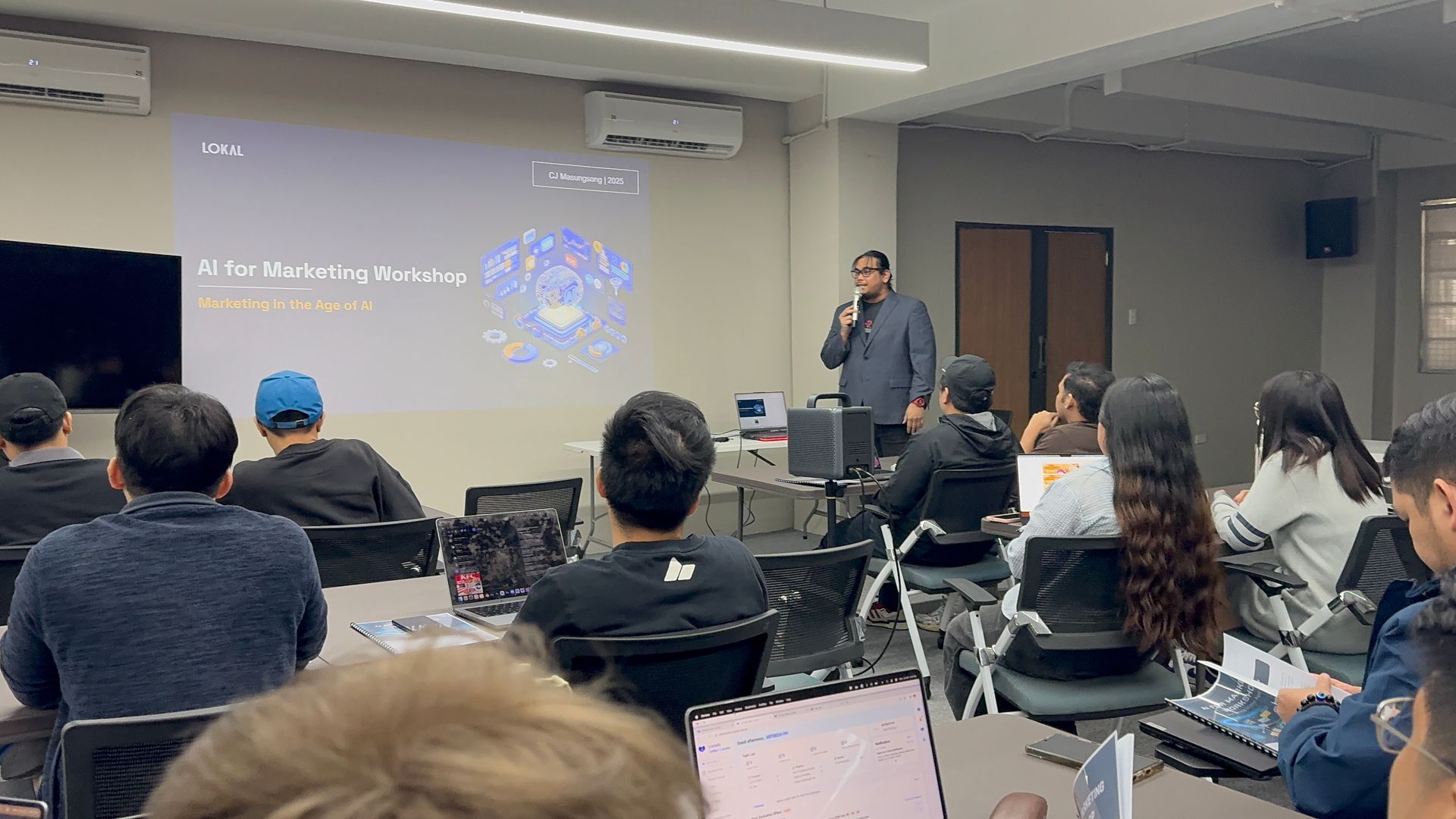
That’s how we ran Great Deals: four tracks — CX, quality & compliance, security & data, infrastructure — each building its own artifact, from a support-scenario library to a security runbook template. And Aboitiz: four corporate functions, including an investment-intelligence workspace for their analysts and a data-to-narrative workflow for strategic comms. Same company-wide rollout, different training underneath it — which is why it survives contact with the workday.
What a program includes
Six building blocks, scoped to your headcount.
Not every company needs all six on day one — the scoping call decides the mix. But every rollout that sticks has the same spine: hands-on teaching, department-level relevance, leadership cover, and measurement.
Everyone
All-staff AI foundations
A half-day, hands-on floor for the whole company — opened with Lakbay AI, our gamified first hour for people who have never really used AI. Everyone is working on a real task by minute 15.
Each team
Department tracks
CX, finance, marketing, compliance, ops, engineering — each track trains on its own weekly workflows and leaves with a working deliverable: a prompt library, a QA suite, a runbook the team uses the following Monday.
Leadership
Executive briefing
The 2–3 hour session that sets policy, budget, and guardrails before the teams train — because adoption stalls when leadership hasn’t decided what AI is allowed to touch.
Your bench
AI champions
We identify and equip internal champions during the rollout — the people who run team-level practice and keep the adoption curve from collapsing after we leave.
The proof
30/60/90 measurement
A usage baseline, check-ins at day 30 and day 60, and a day-90 adoption review. You see weekly-use numbers per department — not a happy-sheet score.
The rules
Governance & guardrails
A plain written rule on what data and tasks AI can touch, and human-in-the-loop verification for facts, figures, and tone. Cautious teams adopt faster when the line is clear.
Who runs it
Your trainers run AI inside a working business every day.
We’re operators, not lecturers. LOKAL is a member of the Claude Partner Network and the OpenAI Champions Network, and the people in front of your teams use these tools daily on client work — so the answers hold up when your staff ask about their real cases.
CJ Masungsong
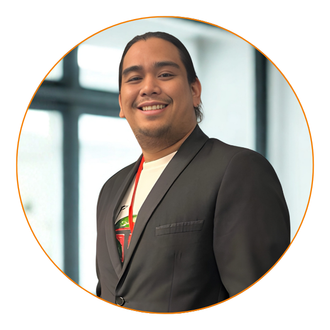
Director of Training & Marketing. Twenty years in sales and marketing; has personally led 20+ LOKAL sessions for hotels, retail brands, and enterprise teams. CJ uses AI daily across campaign planning, client work, and content production — so your teams learn what works in practice, not what looks good in a framework deck.

Joshua Pielago
Founder · OpenAI Champions Network. Runs AI across LOKAL’s agency and training operations. A member of the OpenAI Champions Network, Joshua has advised on AI adoption across retail, hospitality, media, and enterprise sectors in the Philippines.

Ramon King III
Co-Founder · Managing Director. Brings the operational and commercial lens to every rollout — keeping the program tied to delivery reality and the numbers your leadership is accountable for.
The 90-day arc
Adoption spikes, dips, then holds — or quietly collapses.
Teaching a tool takes a day. Keeping a whole company using it takes a method. The 30/60/90 checkpoints exist to catch the dip before it becomes a write-off — this is the arc every LOKAL rollout runs on.
-
Days 1–30
The spike
Foundation
The teaching phase — and the baseline that makes day 90 measurable.
- All-staff foundations, then department tracks for priority teams
- Champions identified inside each team
- Baseline set: who’s using AI, and on what
-
Days 31–60
The dip
Expansion
Where the novelty wears off — and the method keeps the habit from fading.
- A 30-day check-in against the baseline
- Champions run team-level practice
- Prompt libraries refined on real work
-
Days 61–90
It holds
Integration
AI stops being “the tool from training” and becomes how the work gets done.
- AI workflows written into standard operating procedures
- A 60-day check-in catches the stragglers
- A day-90 adoption review, reported per department
Proof
The numbers from a 4,000-staff enterprise rollout.
Attendance isn’t a result. These are usage numbers — measured after the applause, when old habits try to reassert.
4,000 Staff trained in one rollout
72% Using AI weekly at six months
46% Still using it daily at six months
98% Training-client satisfaction
How it starts
Scoped like a rollout, not booked like an event.
Scoping call
Headcount, departments, the tools you already pay for, and what “working” should mean in numbers — before anyone books a training room.
Workflow mapping
We find the two or three weekly workflows per department that eat the most time, and build every session around those — never generic demos.
Pilot track
One team with an engaged manager trains first. You get a real adoption number and your first champions before the company-wide spend.
Company rollout
The remaining tracks sequenced over weeks, champions activated, and the 30/60/90 measurement layer running underneath all of it.
What we don’t do
The fastest way to waste a training budget is to buy the wrong thing.
- One-and-done keynotes. A single session with no follow-through is the most common failure mode in corporate AI training — we won’t sell it to you as a rollout.
- Generic demos. If the exercise isn’t your team’s actual work, it creates interest, not habit.
- Attendance as proof. If the success metric is who showed up, you’ll get attendance and nothing else — we measure weekly use at 30, 60, and 90 days.
- Tool lock-in. We’re tool-agnostic across ChatGPT, Claude, Copilot, and Gemini — we train on the stack you already pay for.
Corporate AI training clients across the Philippines





FAQs
Corporate AI training — straight answers.
What does corporate AI training with LOKAL include?
Five parts, scoped to your headcount: an all-staff foundations session, department tracks trained on each team’s real workflows, an executive briefing for leadership, an internal champions network, and a 30/60/90-day adoption plan with measurement. Formats run from a half-day workshop for one team to a multi-week, company-wide program.
How much does corporate AI training cost in the Philippines?
It depends on headcount, formats, and how much custom workflow design is involved — a one-off team workshop sits at the low end, a multi-month enterprise program with adoption tracking and governance sits much higher. Tool licences are separate (ChatGPT, Claude, Copilot and Gemini business plans are all paid — check each provider’s current pricing). We scope and quote against your actual situation on a call rather than handing you a generic per-head figure.
Should we train the whole company at once or start with one department?
Start with one team that has a clear, repetitive workflow and an engaged manager. A contained pilot gives you a real adoption number and a few internal champions before you spend on the company-wide rollout — scaling a proven pilot is far cheaper than rescuing a stalled all-hands launch.
How do you measure whether the training actually worked?
Not by attendance or a happy-sheet score. We track weekly active use on real work, daily use at 60 and 90 days, and time saved on the specific workflows each department trained on. In our 4,000-staff enterprise rollout, 72% were using AI weekly and 46% were still using it daily at the six-month mark.
Can you train teams outside Metro Manila?
Yes. We run onsite corporate training across Metro Manila and major hubs, and live online training anywhere in the Philippines — same trainers, same hands-on format. Sessions run in English or Taglish, whichever your teams actually speak.
Which AI tools do you train employees on?
We’re tool-agnostic: ChatGPT and Custom GPTs, Claude and Claude Projects, Microsoft 365 Copilot, and Google Gemini with NotebookLM — matched to the stack your company already pays for. LOKAL is a member of the Claude Partner Network and the OpenAI Champions Network, and we teach from daily practice.
Do our employees need a technical background?
No. Most participants are non-technical — operators, marketers, finance, HR, CX, and sales teams. Every session is hands-on from the first 15 minutes, built on the work your people already do, with no coding anywhere in the program.
Do you run one-off AI seminars for employees?
Yes — we run half-day AI seminars and workshops for employee groups across the Philippines, and they’re a good first exposure. We’ll be straight with you though: a seminar creates interest, not habit. For adoption that holds, most companies pair that first session with department tracks and the 90-day plan.
How is this different from sending staff to an AI course?
A course teaches individuals a skill on generic material. A corporate program builds an organisational capability: every department trains on its own workflows, leadership sets the guardrails, champions keep practice going, and adoption is measured at 30, 60, and 90 days. Courses are the right tool for a few people — a program is how a whole company changes how it works.
Logistics & pricing
Sized to the room — from a 10-person team to a 4,000-staff rollout.
Format: onsite across Metro Manila and major hubs, or live online anywhere in the Philippines, in English or Taglish. Structure: foundations, department tracks, an executive briefing, champions, and the 30/60/90 measurement layer — mixed to fit your headcount. Every participant leaves with a certificate, the prompt library their team built, and a 30-day support window. Pricing is quoted per program against headcount, formats, and how much custom workflow design you need — a scoping call sets it.